1. Pivot to answer-first pages
“People visit our website but still call to ask basic questions. What should we change?”
Make it easier to get answers fast. The best-performing pages now clearly state the essentials near the top: what you do, who it’s for, pricing range, timeframes, and next steps.
What to do next
- Add a “Quick Answers” section to your top service pages:
- Price range (or what affects price)
- Typical turnaround time
- Who it’s best for / not for
- What happens next (call, quote, booking)
- Put 6–10 real FAQs on the same page.
- Use plain headings people actually search (e.g. “How much does it cost?”).
Common mistake
- Writing long “about us” copy before answering the question the visitor came for.
2. Pivot from “rankings” to “being included”
“Our rankings look OK, but leads feel down. What’s happening?”
You can hold rankings and still lose attention because customers see maps, Q&A blocks, and AI-style summaries first. If you’re not showing up in those placements, you’re being skipped.
What to do next
- Track visibility, not only rankings:
- Are you showing in local results for your main suburbs?
- Do you appear when someone searches “best + service + suburb”?
- Do your FAQs appear in search features?
- Strengthen your “answer pages” so your content is more likely to be used in summaries and Q&A formats.
Common mistake
- Celebrating a ranking report while ignoring the actual path customers take to contact you.
3. Pivot to “prove it” marketing
“People compare us to competitors and choose on price. How do we win on value?”
Give customers (and search systems) proof they can trust. Evidence reduces price pressure because it makes your value tangible.
What to do next
- Add proof to every key service page:
- 3–5 testimonials relevant to that service
- Photos of real work (before/after if relevant)
- A short case study (problem → approach → outcome)
- Certifications, memberships, licences (where applicable)
- Build a simple “Evidence” or “Results” page and link to it from your service pages.
Common mistake
- Hiding proof on social media only, instead of putting it on the pages people use to decide.
4. Pivot to local authority (not just a Google profile)
“We have a Google Business Profile. Why aren’t we dominating locally?”
A Google profile is necessary — but local success now depends on local authority: clarity, relevance, trust signals, and helpful local information across your website and profiles.
What to do next
- Create (or improve) location pages for your main areas:
- Services in that area
- Common local questions (parking, access, wait times, travel)
- Reviews that mention the suburb/area
- Clear calls-to-action (call/book/enquire)
- Keep service + suburb wording consistent across your site and your Google profile.
Common mistake
- One generic “service area” page that tries to cover 20 suburbs with no useful detail.
5. Pivot to “make your business easy to understand online”
“People keep confusing us with other businesses (or contacting the wrong place). How do we fix that?”
Consistency wins. If your business name, services, or locations are inconsistent across your website, Google profile, and social pages, you’re harder to find and easier to confuse.
What to do next
- Make these consistent everywhere:
- Business name (spelling and format)
- Primary services (use the same wording)
- Main service areas/suburbs
- Phone number and address details
- Update your website footer and contact page so they match your Google profile exactly.
Common mistake
- Using different service names on each platform (“ear wax”, “wax removal”, “microsuction”) with no clear connection.


AI search is changing what “good marketing” looks like.
Your customers still use Google – but they’re also asking ChatGPT-style questions, and Google is increasingly showing answers, summaries, maps, and Q&A features before people click through to websites.
So the goal is no longer just “get more traffic”. It’s:
- Get found in the answers people see first
- Build trust quickly
- Convert the visits you do get
Below are 10 pivots written as business-problem Q&As (so they’re easy to scan, and easy for AI tools to quote).
6. Pivot to question-led content (not keyword-led content)
“We don’t know what to post anymore. How do we create content that actually brings leads?”
Stop guessing topics and start answering questions customers already ask during the sales process.
What to do next
- Ask your team: “What questions do you answer every week?”
- Turn each question into a short page section or post:
- Cost questions
- Timeframe questions
- Comparison questions (X vs Y)
- “Do I need this?” questions
- “What happens if I do nothing?” questions
- Use the question as the heading, then answer it in 2–4 direct sentences before expanding.
Common mistake
- Posting “awareness content” endlessly without ever addressing buying questions.
7. Pivot to conversion-first pages
“We get website visits, but not enough enquiries. What should we change first?”
Your top pages must make the next step obvious and low-friction. In an answers-first world, fewer clicks can mean every visitor is more valuable — so your conversion rate matters more than ever.
What to do next
- Pick ONE primary action per page: Call / Book / Enquire
- Put that call-to-action:
- Near the top
- Mid-page after proof
- At the bottom with reassurance
- Add “decision helpers”:
- FAQs
- Reviews
- What to expect
- Who it’s best for
Common mistake
- Three competing calls-to-action and no clear “best next step”.
8. Pivot to “quoteable” structure
“Our content is good, but it feels like it doesn’t get picked up. How do we make it easier to use?”
Structure your content so it can be lifted into summaries and Q&A formats. That means clean headings, short definitions, and step-by-step sections.
What to do next
- Add sections like:
- Quick answer
- Steps
- Pricing factors
- Common mistakes
- FAQs
- What to expect
- Use simple, direct sentences early in each section.
Common mistake
- Walls of text that hide the answer and make scanning hard.
9. Pivot to testing “AI answers” (the new customer research)
“Customers say they found competitors through ChatGPT. How do we respond?”
Treat AI tools like a research channel: test what they say about your service category, note patterns, and fix the gaps on your website and profiles.
What to do next
- Create a list of 20 questions customers ask (real sales questions).
- Test them monthly in AI tools and note:
- Who gets mentioned
- What types of pages are referenced
- What wording appears most often
- Use findings to update your service pages, FAQs, and proof.
Common mistake
- Assuming “AI is random” and doing nothing while competitors improve their presence.
10. Pivot to an AI-era scoreboard
“How do we measure marketing success when search is changing so fast?”
You need a combined scoreboard: leads/conversions plus visibility in the placements customers see first.
What to do next
Track these monthly:
- Leads (calls, forms, bookings)
- Conversion rate on your top 3 pages
- Local visibility (main suburb searches)
- Presence on key questions (“cost”, “best”, “near me”, “X vs Y”)
- Content production tied to real customer questions
Common mistake
- Reporting only traffic and rankings, then wondering why enquiries don’t follow.
How visible is your business in AI search right now?
This article talks about the shifts — but where do you actually stand? Our free AI Visibility Assessment shows you exactly how your website appears across ChatGPT, Google AI Overviews, AI Mode, and Gemini. You’ll see which topics and prompts mention your brand, where competitors are showing up instead of you, and the specific opportunities you’re missing. It’s the scoreboard from Pivot #10 – delivered to your inbox.
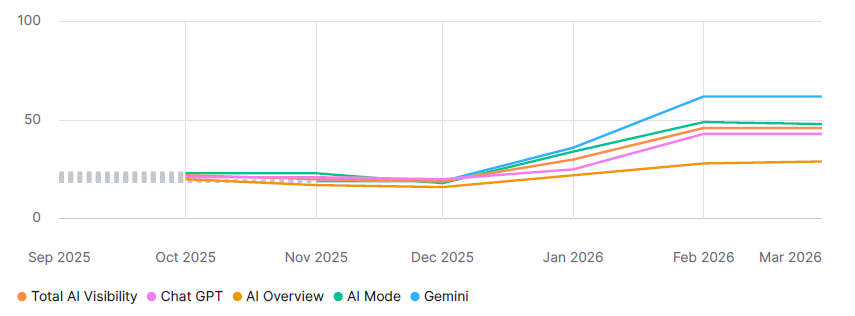
Get your free AI Visibility Assessment
Fill out the form below and we’ll send your personalised report within 48 hours.
Want help being AI Visible?
If you’re a business owner or marketing manager and you want practical changes (not buzzwords), we can help you:
- Rewrite your key pages into answer-first pages
- Build an evidence system (reviews, case studies, proof blocks)
- Improve local visibility across your service areas
- Set up an AI-era reporting scoreboard
Contact Web Intelligenz for AI consulting and digital marketing strategy